Finance Brain
Courses
Sign in
← Back to decks
Sign in to save your progress, vote, and build your own decks.Sign in

Bitcoin vs Gold

One of the most persistent Bitcoin investment theses is that it is, or will become, a digital analogue to gold — a store of value that preserves purchasing power over time, independent of any government or central bank. Proponents argue that Bitcoin improves upon gold in several key dimensions…

4 cards
Study this deck

Bitcoin vs Gold

The Digital Gold Thesis

A gleaming golden vault door stands open.

Photo by luca romano on Unsplash

One of the most persistent Bitcoin investment theses is that it is, or will become, a digital analogue to gold — a store of value that preserves purchasing power over time, independent of any government or central bank. Proponents argue that Bitcoin improves upon gold in several key dimensions. Sceptics argue the comparison flatters Bitcoin with gold's 5,000-year history while understating the differences.

Understanding the specific similarities and differences between Bitcoin and gold is essential for evaluating either as a portfolio holding.

Similarities
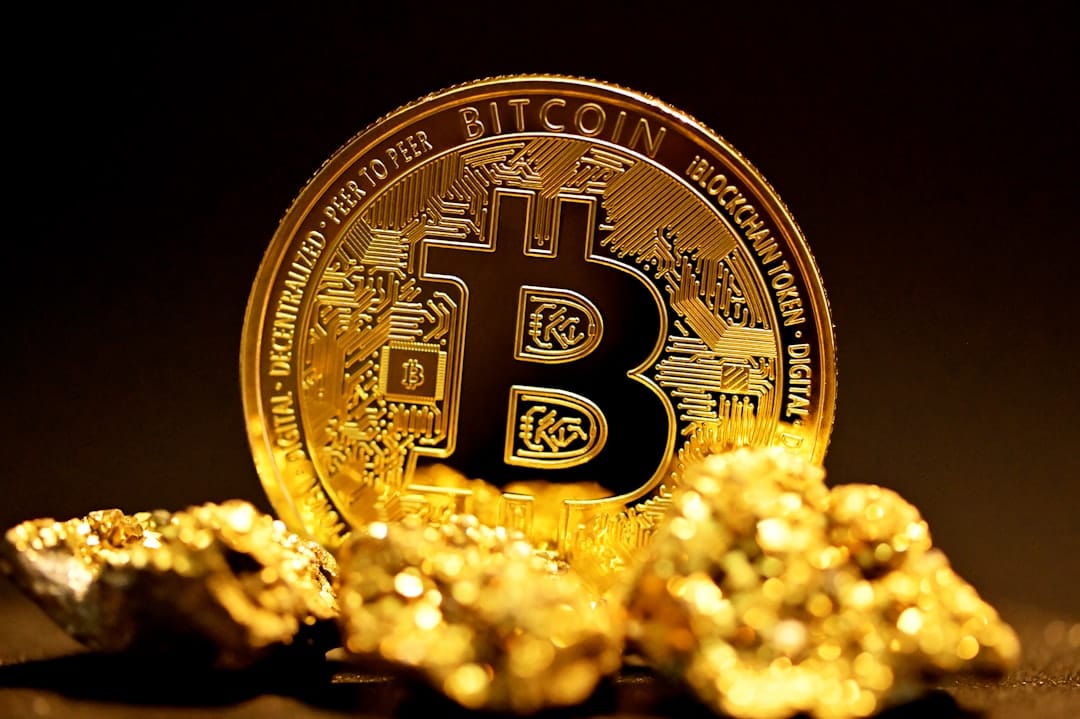
a bitcoin sitting on top of a pile of gold nuggets

Photo by Kanchanara on Unsplash

Scarcity: Gold's supply grows slowly — approximately 1.5–2% annually from mining. Bitcoin's supply grows at a declining rate toward zero. Both are scarce relative to their potential monetary demand.

No counterparty risk: Physical gold and self-custodied Bitcoin both exist outside the financial system. Unlike a bank deposit or bond, they represent no liability of any institution and cannot be defaulted on.

Inflation hedge aspiration: Both are held by investors seeking protection against fiat currency debasement. The belief that governments will over time inflate their way out of debt creates demand for assets outside the fiat system.

Divisibility: Both can be subdivided. Bitcoin is divisible to 8 decimal places (1 satoshi = 0.00000001 BTC), making it usable for very small transactions.

Differences

Server rack with blinking green lights

Photo by Domaintechnik Ledl.net on Unsplash

Track record: Gold has functioned as money and a store of value for over 5,000 years across every civilisation. Bitcoin is 15+ years old. The difference in validated history is enormous.

Volatility: Gold is relatively stable in purchasing power over long periods. Bitcoin has experienced drawdowns exceeding 80% multiple times. An 80% drawdown is incompatible with reliable store-of-value function on any normal investment horizon.

Industrial demand: Gold has significant industrial uses (electronics, dentistry) and jewellery demand that provides a fundamental demand floor independent of investment demand. Bitcoin has no use case that is not directly financial.

Physical vs digital: Physical gold exists in the material world and cannot be hacked or suffer a software bug. Bitcoin's security is entirely dependent on cryptography, software, and the continued existence and decentralisation of the mining network.

Regulatory clarity: Gold is unambiguously legal globally. Bitcoin's regulatory status varies significantly across jurisdictions and has faced periodic bans and restrictions.

Educational content only. Not financial, investment, tax or legal advice. Learn more

Quiz me on this
What does "no counterparty risk" mean in the context of both gold and Bitcoin?
  1. Neither gold nor Bitcoin requires a broker or bank account to hold, meaning they generate no transaction fees
  2. ✓ Physical gold and self-custodied Bitcoin are not liabilities of any institution — they cannot be defaulted on or seized through the insolvency of a counterparty the way a bank deposit, bond, or ETF can in extreme scenarios
  3. Neither gold nor Bitcoin is subject to capital gains tax, removing the counterparty of the tax authority
  4. Holding gold or Bitcoin eliminates currency exchange risk because they are priced in universal units
What is the most significant objection to Bitcoin as a proven store of value compared to gold?
  1. Bitcoin has never been adopted by central banks as a reserve asset, unlike gold
  2. ✓ Bitcoin's 15-year history includes multiple drawdowns exceeding 80%, which is incompatible with reliable store-of-value function; gold's track record as a purchasing power preserver spans over 5,000 years across diverse civilisations and crises
  3. Bitcoin is not accepted as payment for taxes in any jurisdiction, unlike historical gold-backed currencies
  4. Bitcoin's supply is unlimited, unlike gold, making it inherently inflationary
What property does gold have that Bitcoin lacks, which provides a demand floor independent of investment sentiment?
  1. Gold is accepted by all central banks as a tier 1 reserve asset under Basel III regulations
  2. ✓ Gold has substantial industrial and jewellery demand — from electronics manufacturing, medical applications, and consumer goods — that continues even during periods of low investor demand, providing a fundamental price floor; Bitcoin has no comparable non-financial use case
  3. Gold is backed by the US government's strategic reserve guarantee, providing a minimum price
  4. Gold can be legally tendered in payment of debts in most jurisdictions, unlike Bitcoin
How does Bitcoin's regulatory status differ from gold's as a consideration for investors?
  1. Gold is subject to strict export controls while Bitcoin flows freely across all borders
  2. ✓ Gold's legal status as an asset is unambiguous and universally permitted globally; Bitcoin faces significant regulatory variance — some countries have banned it, others have made it legal tender, and its classification (commodity, security, currency) varies by jurisdiction — creating legal and practical risks that gold investors do not face
  3. Bitcoin benefits from stronger investor protection regulations than gold in most OECD countries
  4. Gold is subject to a global commodity tax that Bitcoin avoids by virtue of its digital classification