
Finance Brain
Courses
Sign in
← Back to decks
Sign in to save your progress, vote, and build your own decks.Sign in

Ethereum and Smart Contracts

Ethereum was proposed by Vitalik Buterin in a 2013 whitepaper and launched in July 2015. Its defining innovation was the smart contract: self-executing code stored on the blockchain that runs automatically when predefined conditions are met, without requiring a trusted intermediary to enforce the…

4 cards
Study this deck

Ethereum and Smart Contracts

Programmable Money

A computer screen with a program running on it

Photo by Mohammad Rahmani on Unsplash

Ethereum was proposed by Vitalik Buterin in a 2013 whitepaper and launched in July 2015. Its defining innovation was the smart contract: self-executing code stored on the blockchain that runs automatically when predefined conditions are met, without requiring a trusted intermediary to enforce the agreement.

Bitcoin enabled trustless transfer of value. Ethereum extended this to trustless execution of logic. A smart contract behaves like a vending machine: insert the required inputs, and the outputs are automatically delivered as specified — no human discretion, no counterparty who can refuse to perform, no institution to trust.

What Smart Contracts Enable

person using laptop computer beside aloe vera

Photo by Corinne Kutz on Unsplash

Decentralised Finance (DeFi): lending protocols (Aave, Compound), automated market makers (Uniswap), and yield aggregators built entirely in code. Users can borrow, lend, and trade without a bank, broker, or exchange intermediary. The protocol rules are public and immutable.

Non-Fungible Tokens (NFTs): unique digital assets with ownership recorded on the Ethereum blockchain. NFTs created new models for digital art ownership, gaming item ownership, and intellectual property — though the 2021–2022 NFT bubble saw significant speculative excess.

DAOs (Decentralised Autonomous Organisations): organisations governed by smart contract rules and token-holder voting rather than directors and legal structures.

Layer-2 Scaling: networks built on top of Ethereum (Arbitrum, Optimism, Polygon) that process transactions off the main chain and settle on Ethereum — reducing fees and increasing speed.

Ether as an Investment
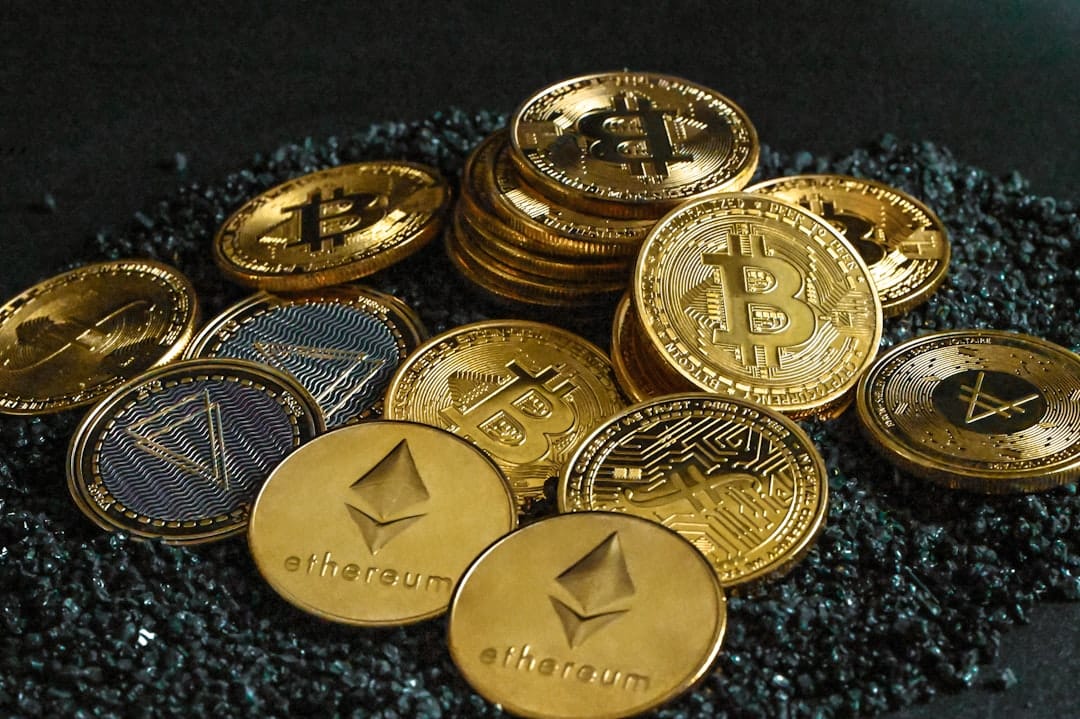
a pile of bitcoins sitting on top of a pile of gravel

Photo by Traxer on Unsplash

Ether (ETH) is the native currency of the Ethereum network. It is required to pay gas fees — the cost of executing transactions and smart contracts. Unlike Bitcoin, ETH does not have a fixed supply cap; however, since the 2021 EIP-1559 upgrade, a portion of every gas fee is burned (permanently removed from supply), making Ether partially deflationary in periods of high network usage.

Ethereum completed its transition from Proof of Work to Proof of Stake in September 2022 (the "Merge"), reducing energy consumption by approximately 99.95% and introducing staking rewards for ETH validators.

Educational content only. Not financial, investment, tax or legal advice. Learn more

Quiz me on this
What is the fundamental difference between what Bitcoin and Ethereum enable?
  1. Bitcoin enables faster transactions while Ethereum enables larger transaction sizes
  2. ✓ Bitcoin enables trustless transfer of value (digital money); Ethereum extends this to trustless execution of logic through smart contracts — enabling decentralised applications, financial protocols, and programmable agreements to run without intermediaries
  3. Bitcoin is a public blockchain while Ethereum is permissioned, restricting access to verified developers
  4. Bitcoin uses proof-of-work while Ethereum uses proof-of-stake, determining their respective energy consumption but not their different functionality
What is DeFi, and what problem does it attempt to solve?
  1. Decentralised Finance — a government initiative to extend financial services to underbanked populations using blockchain technology
  2. ✓ Decentralised Finance — financial services (lending, borrowing, trading, yield) built on smart contracts that operate without institutional intermediaries; it attempts to solve the problem of counterparty and institutional trust by replacing intermediaries with transparent, auditable code
  3. Digital Finance — a rebranding of traditional fintech services using blockchain for settlement efficiency
  4. Distributed Finance — a system for distributing bank profits to customers using cryptocurrency token rewards
What effect did the EIP-1559 upgrade have on ETH supply dynamics?
  1. It introduced a fixed supply cap of 120 million ETH, mirroring Bitcoin's scarcity model
  2. ✓ It introduced base fee burning — a portion of every transaction fee is permanently destroyed — making ETH net deflationary during periods of high network usage, as more ETH is burned than newly issued to validators
  3. It reduced the block reward by 50%, functioning as Ethereum's equivalent of a Bitcoin halving
  4. It transferred all transaction fee revenue from miners to the Ethereum Foundation endowment
What was the significance of the Ethereum "Merge" in September 2022?
  1. The Merge combined the Ethereum and Ethereum Classic networks into a single unified blockchain
  2. ✓ The Merge was Ethereum's transition from energy-intensive Proof of Work to Proof of Stake consensus, reducing the network's energy consumption by approximately 99.95% and introducing staking as the mechanism for block validation
  3. The Merge combined Ethereum's mainnet with its leading layer-2 networks, reducing transaction costs by processing all transactions on a single chain
  4. The Merge was the integration of Ethereum's development team with the Bitcoin Core developer community to share security research